
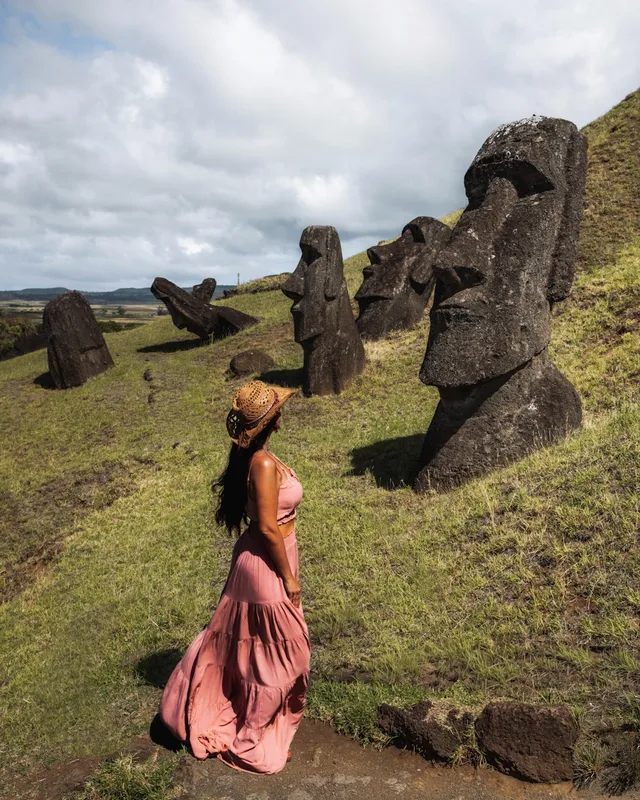
When we first started planning our trip through South America, there was one destination we'd dreamed about visiting more than any other.
Easter Island.
For years we'd imagined standing beneath the towering moai at sunrise, exploring volcanic landscapes at the edge of the world and discovering the heart of one of Polynesia's most fascinating cultures. It always felt like one of those once-in-a-lifetime places that somehow lived up to its reputation.
It exceeded every expectation.
Most couples picture tropical beaches or luxury resorts when planning a honeymoon. And while we love destinations like the Maldives for exactly that reason, Easter Island offers something completely different.
This is a honeymoon for couples who are endlessly curious.
A place where every ancient stone platform, every carved statue and every volcanic crater tells part of a story that historians are still trying to piece together. A place where you'll learn about remarkable Polynesian voyagers who navigated thousands of kilometres across the Pacific long before modern instruments existed, eventually settling one of the most isolated inhabited islands on Earth.
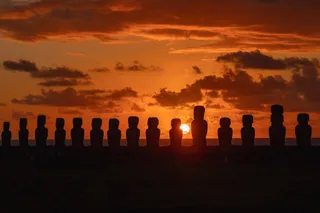
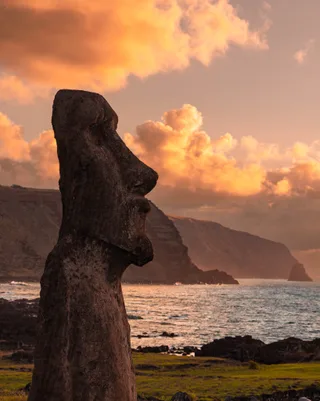
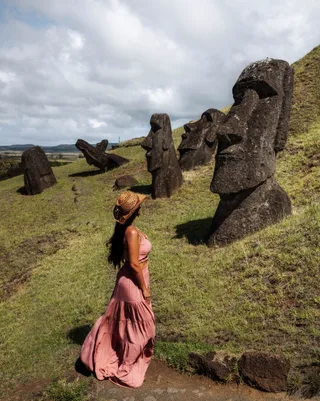
One morning we stood hand in hand as the first rays of sunlight slowly revealed the fifteen moai of Ahu Tongariki, their backs to the endless Pacific, just as generations of Rapa Nui people have watched the sunrise for centuries. Later that afternoon we wandered through Rano Raraku, the volcanic quarry where hundreds of moai remain frozen in time—some half buried, others still attached to the rock they were carved from—as though an entire civilisation simply paused its work and never returned.
The more we explored, the more questions we had.
How were these enormous statues moved across the island? Why was their construction abandoned? What was life like for the Polynesian people who built one of the world's most remarkable archaeological landscapes in almost complete isolation?
You'll leave with plenty of theories, but very few definitive answers. And that's exactly what makes Easter Island so unforgettable.
Beyond the ancient sites, we found ourselves falling in love with modern Rapa Nui culture too. Watching traditional dancing during the Tapati Festival, listening to stories passed down through generations, tasting local seafood, and discovering a community fiercely proud of its Polynesian heritage made the island feel alive in a way few archaeological destinations ever do.
This isn't the kind of honeymoon where you'll spend every day beside an infinity pool.
It's for couples who dream about sharing extraordinary experiences together. Watching the sunrise over one of the world's greatest archaeological mysteries. Learning about a culture unlike any other. Driving empty coastal roads where wild horses roam freely and the Pacific stretches endlessly towards the horizon.
If your idea of romance is returning home with incredible stories rather than simply a tan, Easter Island might just become your favourite destination in the world.
It certainly became one of ours.
What's in a Name?
The name most people know, Easter Island, was given by the Dutch explorer Jacob Roggeveen, who became the first recorded European to reach the island on Easter Sunday in 1722. In Chile they use the direct Spanish translation Isla de Pascua.
But long before European ships appeared on the horizon, the island already had names of its own.
The name you'll hear most often today is Rapa Nui. While it has become synonymous with the island itself, it's also the name of the island's Indigenous Polynesian people, their language, and their vibrant culture. Today, "Rapa Nui" is widely used by locals and visitors, reflecting the island's deep Polynesian identity.
But it also has some older traditional names, one being Te Pito o Te Henua which is often translated as "The Navel of the World" or "The End of the Land." Depending on interpretation, it can represent either the spiritual centre of the world or one of the last pieces of land before the endless Pacific. Standing on the island's rugged coastline with nothing but ocean stretching to the horizon, both meanings feel equally fitting.
Another ancient name, Mata-ki-te-rangi, means "Eyes Gazing Skyward." Some believe it reflects the extraordinary navigation skills of the early Polynesian voyagers, who crossed thousands of kilometres of open ocean guided by the stars. Others associate it with the island's moai, whose upward gaze has inspired countless interpretations over the centuries.
Whichever name you choose, each reveals something different about the island, its remarkable isolation, its enduring Polynesian heritage, and the sense of mystery that continues to captivate travellers from around the world.
Why Rapa Nui is Unlike Anywhere Else
Before visiting, we knew Easter Island was remote, we just didn't fully appreciate how remote.
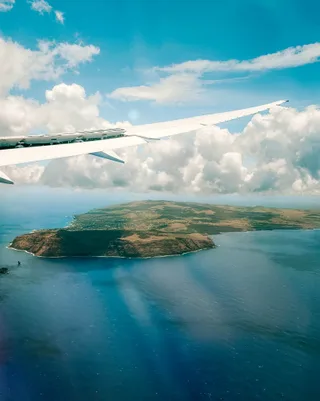
Looking out the aeroplane window during our descent, there was nothing but the endless blue of the Pacific Ocean. Then, almost impossibly, a small triangle of green appeared on the horizon. That was it.
No neighbouring islands. No chain of volcanoes stretching into the distance. Just one tiny island, sitting alone more than 3,500 kilometres from mainland Chile.
It's one of the most isolated inhabited places on Earth.
Known as Rapa Nui to its Indigenous Polynesian people and Isla de Pascua to Chile, the island is home to around 7,700 people and approximately 900 moai, the enormous stone statues that have fascinated travellers and archaeologists for centuries.
But the moai are only part of the story.
Long before European explorers reached these shores, Polynesian navigators crossed thousands of kilometres of open ocean using nothing more than the stars, ocean swells, bird migrations and generations of knowledge passed down through oral tradition. We even heard stories that they used turtles to help them navigate. Their achievement remains one of humanity's greatest feats of exploration, and standing on Rapa Nui, it's impossible not to wonder how they ever found this tiny island in the vastness of the Pacific, and appreciate the bravery of those early navigators setting off into the unknown.
Today, that remarkable Polynesian heritage is still very much alive.
From the Rapa Nui language and traditional music to the annual Tapati Festival, the island isn't simply an archaeological site frozen in time—it's a living culture with deep connections to its ancestors and an inspiring determination to preserve its identity.
The island itself is surprisingly small, measuring just 25 kilometres long and 12 kilometres wide. Almost everyone lives in the colourful seaside town of Hanga Roa, while the rest of the island is a patchwork of volcanic craters, rolling grasslands, dramatic cliffs and sacred ceremonial sites overlooking the Pacific.
It's the kind of destination that constantly leaves you wondering.
How were the moai transported across the island?
Why were so many left unfinished?
What caused one of Polynesia's most remarkable civilisations to change so dramatically?
You'll hear different theories from guides, archaeologists and locals throughout your visit. We had some fun probing them on some more out there theories.
But that's part of the magic. Rather than revealing all of its secrets, Rapa Nui invites you to explore, question and form your own opinions. By the time we left, we had far more questions than when we arrived—and somehow that made us love the island even more.
Getting There
Part of Easter Island's magic is that getting there still feels like an expedition.
There isn't a network of international flights or island-hopping ferries. You can't simply add it onto another beach holiday. Reaching Rapa Nui takes a little planning, but we think that's exactly what makes finally arriving feel so special.
For most travellers, the journey begins in Santiago, Chile. From there, LATAM operates the regular flights to Mataveri International Airport (IPC), with the journey taking around five and a half hours across nothing but open Pacific Ocean. There are occasional seasonal flights from Lima, Peru, but Santiago remains by far the most reliable gateway.
Return flights from Santiago typically run around USD $300–600 depending on the season and how far in advance you book. Book early because flights often fill up. We booked late and flight comparison sites were showing the cheapest prices over $1000 but the same flights on the LATAM Chile site (in Spanish) were $500 return so it's worth checking the airline's site directly.
Island Itinerary
We decided to book a group tour for the first day and then a private tour the second day for the sights we were most interested in. The group tour was great, led by an enthusiastic local guide but it turned out to be the second day of a 2 day tour so we missed a lot of the background information.
The first tour covered the south and interior of the island. Highlights included the seven moai at Ahu Akivi, the lava tubes at Ana Te Pahu, the Rano Kau volcano crater and Orongo ceremonial village where we learned about the bird man competition.
Sunrise at Ahu Tongariki
For our second day we planned to visit the places we could go without a guide. Our insider advice was that we could visit Ahu Tongariki, the famous sunrise spot, if we stayed on the road behind a low wall. Of course to get inside and up close to the moai you need to visit with a guide. We got there nice and early and everyone else there was going inside so we were a bit unsure where to set up for a sunrise view from the road. We were able to figure it out using our sun tracker app (great tool for photographers). We stood there in the dark and waited, and the sky started to change, and at some point one of us reached for the other's hand and we stayed like that until the sun started to peek between the moai. Turned out to be well worth the early wake up with a spectacular sunrise behind the 15 moai.
The Rule Change at Ahu Nau Nau (Read This Before You Go)
After sunrise we headed for Ahu Nau Nau. We had recommendations from our guest house manager, our guide from the previous day and online that this was one of the last remaining moai sites that you can visit without a guide. We arrived a bit early and someone working there told us to come back in an hour, but then when we did come back we were told by someone else that we needed a guide to enter. Very hard to find any up to date information. We later heard the reason... It is right next to the beach though...
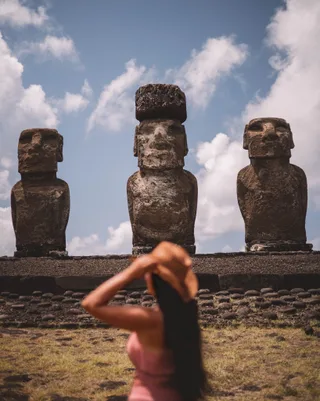
Ahu Nau Nau is the moai platform at Anakena beach — seven restored statues, some still wearing their red topknot stones, set against the backdrop of the island's only proper swimming beach. It's one of the most photogenic sites on the island. And every travel post we read before we left — plus two locals we specifically asked — told us it was accessible without a guide.
It is not. Or at least, it wasn't when we visited.
The rules around which sites require guides have changed, and not everything online reflects the current situation. We arrived at Anakena confidently, walked up toward the platform, and were turned back by a park ranger. No guide, no entry. We could see the statues from the beach. We could not get close to them.
We say this not to discourage — we ended up having a perfectly good afternoon at Anakena beach anyway — but because this is exactly the kind of thing that will ruin your day if you've planned around it. Before you visit, check the current access rules for every site you plan to see independently. The Rapa Nui National Park regulations change, and the travel internet takes years to catch up.
The beach itself, for what it's worth, is beautiful. Palm trees (supposedly planted by Thor Heyerdahl in the 1950s), pale sand, and the kind of clear turquoise water that makes you completely forget you're on a volcanic island in the middle of the Pacific. We stayed for two hours and didn't need the moai to justify the trip.
Take 2 - back to Ahu Tongariki and Ahu Nau Nau
The next day we organised our private tour to visit the highlights of the island. We started early with another sunrise visit to Ahu Tongariki, this time with a guide so we could go inside and get up close to the ahu. We thought it was worth it to go inside and get a bit closer but honestly the view from outside was just as impressive and is also a good optin to save money. Although we had the same guide for the whole day they usually do the morning tour separately to the day tour with a break for breakfast back at Hanga Roa.
Rano Raraku: The Moai Factory
After breakfast we returned to the north and again visited Ahu Nau Nau and this time were allowed in with our guide. After that the highlight of the island...
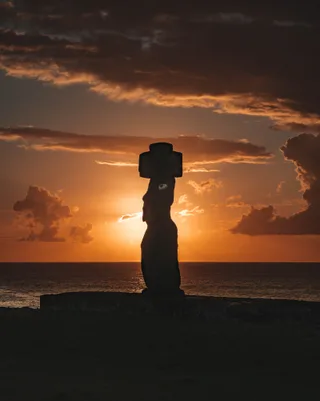
Ask us which site on Easter Island moved us most and we'll give you an answer that surprises most people: not the famous Ahu Tongariki with its fifteen standing moai, not the single sentinel at sunset — but Rano Raraku, the volcanic quarry where almost all the moai were carved.
Rano Raraku is where the island's secrets feel most dense. Nearly half of all moai ever made are still here — some upright, some half-finished, some buried to their necks in the hillside so that they appear to be emerging slowly from the earth. The quarry was abandoned mid-production, no one is entirely sure why, and so you walk among statues in various states of completion. Some have faces but no bodies. Some have bodies but were never detached from the rock. The largest would have been over twenty metres tall and weighed hundreds of tonnes. It was never finished.
There is something genuinely eerie about standing in the middle of all this suspended intention — an entire civilisation's project, stopped mid-sentence. We spent longer here than at any other single site, and both of us agreed later it was our favourite of the whole trip.
Tapati Rapa Nui: The Festival and Living Polynesian Culture
We timed our visit to catch the end of the Tapati festival, which runs for two weeks in late January and early February, and this completely changed the character of the island.
Tapati is a competition between two families or clans for points accumulated across a week of traditional cultural events — canoeing, body painting, food preparation, traditional music, sliding down the hillside at Maunga Puna Pau on a sled made of banana trunks at speeds that made us genuinely nervous for the participants. The winning clan's candidate is crowned queen of the island for the following year. The whole thing has the energy of a community sports day crossed with a cultural festival crossed with something much older and harder to define.
As visiting couples, we were completely welcomed as spectators. No tickets, no formality — you simply turn up to whatever event is happening and watch. The competitive energy between the two clans was intense and good-humoured. The drumming and dancing at the evening performances in Hanga Roa were extraordinary.
If you can align even three or four days of your trip with Tapati, do it without hesitation. It's the reason we recommend January as the best time to visit over any other month.

Where to Stay on Easter Island
Easter Island has one town — Hanga Roa — and almost all accommodation is here or within a short distance. There are no resort clusters. No beach strip with identical hotels. What you get instead is a mix of small boutique lodges, locally run guesthouses (residenciales), and two genuinely impressive luxury properties.
At the top end, Nayara Hangaroa (the former Hotel Hanga Roa) sits on the cliffs above Hanga Roa with an infinity pool, a spa, and views across the ocean that are frankly unreasonable for a hotel on a remote Pacific island. It has had a complex history with indigenous land rights — a dispute with the Hitorangi clan that was settled in 2020 — which is worth reading about before you stay. The physical property itself is stunning.
Explora Rapa Nui takes a different approach: all-inclusive, with guided excursions built into the rate. For couples who want everything handled and to focus entirely on the experience rather than the logistics, it's worth the price. Set on a hillside with panoramic views. Altiplanico Easter Island offers a similar aesthetic intimacy at a lower price point, with design inspired by traditional Rapa Nui architecture and a small pool that makes for a very good afternoon.
One strong practical note for all accommodation: book well in advance if you're visiting during Tapati. The island genuinely fills up, and last-minute options will be limited.
Practical Notes
Getting There
LATAM Chile is the only carrier serving Easter Island. Daily flights from Santiago, around 5 hours. Book early because flights are limited and often fill up. Return from Santiago to Easter Island typically USD $300–600. We booked late and flight comparison sites were showing the cheapest prices over $1000 but the same flights on the LATAM Chile site (in Spanish) were $500 return so it's worth checking the airline's site directly.
National Park Fee
Currently USD $100 per person, you need it to enter most sites. We paid online before arrival and got a qr code to show at the entrance to each site. You can also pay at the airport on arrival. Tickets are valid for 10 consecutive days from the date of your first entry but only a single entry is permitted to the 2 most iconic sites, Rano Raraku and Orongo.
What to Budget
Accommodation from around USD $80/night (basic guesthouse) to USD $600+/night (Nayara Hangaroa or Explora). Guided day tours around USD $60–75 per person. The private sunrise tour around USD $120/person. Car hire roughly USD $60–80/day. Restaurant meals in Hanga Roa are pricier than the Chilean mainland — budget around USD $20–35 per person for a sit-down dinner.
Money
Chilean pesos (CLP) are the currency. Some places accept USD at reasonable rates, but CLP is safer. There are ATMs in Hanga Roa. Stock up — there's one bank and limited card acceptance outside town.
Connectivity
Chilean SIM cards work in Hanga Roa but coverage is patchy to non-existent once you're out at the sites. Download maps offline before you leave town.
Site Access Rules
Rules about which sites require guides have changed recently and the information online hasn't always kept up. Verify current access requirements before you plan any self-guided days. Sites close to Hanga Roa (Tahai, Ahu Ko Te Riku) are accessible independently. Most of the major sites on the rest of the island currently require a guide.
Cultural Respect
Do not touch, climb, or approach moai outside designated viewing areas. This is law, not suggestion. The Rapa Nui people are in an active and ongoing process of reclaiming their cultural heritage — engage with that story with curiosity and respect. Ask before photographing people, especially during Tapati.
Our Honest Summary
Easter Island is not a relaxing holiday. There are no five-star beaches, no infinity pools overlooking pristine reef, no cocktail menus at sunset (well, not many). If that's what you need, go to the Maldives — we've done that too, and it's wonderful for what it is.
Easter Island is something else entirely. It's the kind of trip you take to be slightly destabilised — to stand in front of something ancient and inexplicable and feel the full weight of how little you understand. The moai don't give you answers. The island doesn't explain itself. You leave with more questions than you arrived with, and somehow that feels exactly right.
For couples specifically: we'd say this is one of the best destinations we've visited together, not despite the lack of conventional resort luxury but partly because of it. You're forced to be present with each other and with the place. The drives between sites are the conversations you don't know you needed to have. The sunrise at Ahu Tongariki, however many times you go, becomes a story you tell together for years.
What we'd do differently: we'd hire a car immediately, skip the scooter phase, and add a half-day for diving — the visibility around Easter Island is exceptional and we didn't make time for it. We'd also book more guide time in advance rather than trying to arrange things once we arrived.
What we wouldn't change: the second sunrise. Driving ourselves back in the dark and watching the sky change. That one was ours alone.
Your Easter Island Questions, Answered
Planning a honeymoon or couples trip to Rapa Nui? These are the practical questions we hear most.
Is Easter Island worth it for couples?
How many days do you need on Easter Island?
Can you visit Easter Island sites without a guide?
How expensive is an Easter Island trip?
Do you need to rent a car on Easter Island?
When is the best time to visit Easter Island?
Which experiences are the highlights that couples should not miss?
Keep Exploring
Planning a romantic getaway? Here are some of our favorite honeymoon destinations for couples who loved this vibe.
Questions about Easter Island? Drop them in the comments, we're happy to help.
Comments