
This post contains affiliate links.
We planned to split our time in Seychelles evenly between the islands. A few nights on Praslin, one full day on La Digue, then a ferry to Mahe for the flight home. Clean, logical, efficient.
Then we arrived on La Digue, hired bicycles from a man at the port, and cycled to a beach that didn't look real. And then another one. And then we discovered the beach on the other side of the island that requires a genuinely challenging walk to reach and rewards you with the specific satisfaction of having a stretch of white sand almost entirely to yourself. By the third morning, we were at the ferry office, quietly changing our tickets home.
Praslin: The Island You Arrive To
We flew into Praslin direct — a decision we'd make again. Skipping Mahe on arrival meant stepping off a small propeller plane straight into the island's unhurried pace, with a rental car waiting and no city traffic to wade through first. If you're coming from Mahe by ferry, give yourself a moment on the boat. The approach to Praslin by water is worth watching.
Where to stay on Praslin
We stayed in an Airbnb apartment and hired a car for the duration, which suited us well. Having a car on Praslin makes a real difference — the island is compact but the roads wind, and some of the best beaches involve a drive followed by a short walk that you wouldn't easily do on foot in the heat.
If the budget stretches further, Constance Lemuria is the aspirational benchmark on Praslin — a resort set at the quieter northern end of the island with access to Anse Georgette, one of the few truly spectacular beaches that normal mortals would otherwise struggle to reach. We didn't stay there. We had lunch there. It was, as these things go, still entirely worth it (more on that below).
For a mid-range alternative with strong reviews and less of a journey to the wallet, Raffles Seychelles at Baie Sainte Anne has its own private beach, villa-style rooms, and the kind of Indian Ocean view that justifies closing the laptop for a week.
Anse Georgette and the Lemuria lunch trick
Here is a thing worth knowing: you do not have to stay at Constance Lemuria to access Anse Georgette. The resort allows outside visitors to walk through the property to reach the beach. What this means in practice is that you can call ahead, book a table for lunch, eat something excellent on a terrace overlooking the ocean, and then spend the afternoon at one of the best beaches on Praslin.
We did exactly this. After lunch — — a member of staff drove us down to the beach in a buggy. The sand was the kind of pale gold that photographs slightly too warm but looks perfect in person. Palm trees leaned over the water at the angle that palms always lean in photographs of places like this. We had coco locos (the local coconut cocktail, served from the shell if you're lucky) and stayed until the light changed.
It is not a free beach day. Lunch is not cheap. But as a way to experience a resort beach without paying resort prices for a room, it is a reasonable piece of arithmetic.
Vallée de Mai and the Coco de Mer
The Vallée de Mai is a UNESCO World Heritage Site — a small, ancient palm forest in the interior of Praslin that is the only place in the world where Coco de Mer palms grow wild. The Coco de Mer produces the largest seed of any plant on earth, shaped in a way that various people throughout history have found either fascinating or embarrassing, depending on their constitution.
The walk takes an hour or two at a comfortable pace. It is genuinely beautiful in that particular way of old-growth forests: quiet, dense, slightly other-worldly. The Seychelles Black Parrot lives here and is very difficult to actually spot, which we learned after spending twenty minutes trying. We heard it. We're counting that.
Boat trips and snorkeling off Praslin
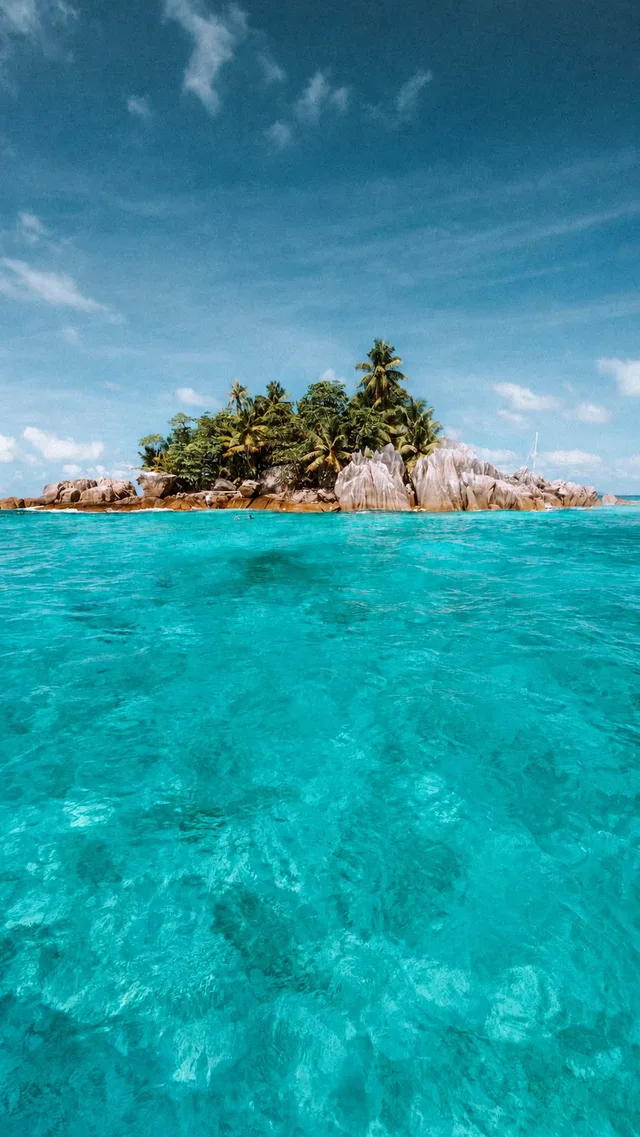
We did a boat trip from Praslin and both strongly recommend it as a day on the water. The standard island-hopping excursion from Praslin visits Curieuse Island and St. Pierre, which covers giant tortoises wandering freely through a mangrove landscape, a guided walk, two or three snorkeling stops in water so clear you can see every scale on every fish, and a Creole barbecue lunch on the island. It is a very good day.
For the organised version, Angel Tours run a well-rated full-day Curieuse and St. Pierre boat trip from Praslin that covers snorkeling, the tortoise sanctuary, and a mangrove hike, with lunch included. Rated 4.9/5 across 1,472 reviews at the time of writing, which is an unusually consistent score for a full-day excursion.
La Digue: The Island You Won't Want to Leave
The ferry from Praslin to La Digue takes about fifteen minutes. When you arrive, there is a port, some people with bicycles for hire, and no real traffic to speak of. There are no private cars on La Digue for tourists (residents have limited vehicles, and there are some farm tractors). You hire a bike, or you walk. That's it.
Within about thirty minutes of arriving, we understood the appeal completely.
Getting around the island
Bicycle hire is available from several places near the port and typically costs very little per day. The bikes are basic. The roads are flat near the coast, hillier if you push into the interior. You can cover most of the island's beaches in a single day if you keep moving, or spend two days doing the same thing more slowly and enjoy it considerably more. We recommend the slower version.
One honest note on security: La Digue has a reputation for being relaxed about bicycle locks — many hire places don't bother with them. This is largely accurate. However, it is not universal. I left my bike outside a supermarket without a lock and came back to find it gone. This is the kind of story that sounds alarming until you hear the end of it.
I went to the police station. They were calm about the whole thing in a way that suggested this had happened before. Within the hour, they had driven me to the hire place, where the owner confirmed he'd seen someone ride past on one of his bikes who had no business riding it. A little later, the police came back with my bicycle. The whole episode took maybe two hours, cost nothing, and produced a story we've told at dinner tables since.
La Digue is safe. The police were excellent. Lock your bike outside supermarkets anyway.
Anse Source d'Argent — and the beaches around it
Anse Source d'Argent is, by the most photographed-beach-in-the-world metric, probably the most famous beach in the Seychelles. The giant granite boulders, the shallow turquoise water, the pale sand — you've seen this photograph. It exists in exactly the form advertised.
Access is through L'Union Estate, a historic vanilla and copra plantation with a small entry fee (). The ticket covers the estate and the beach beyond it, and it's valid for the whole day, so there's no rush. Inside the estate there are giant tortoises, a traditional boat-building area, and colonial-era coconut press equipment that gives some context to how the island earned its living before tourism.
The beach itself is at its best at low tide, when the water recedes into sheltered pools between the boulders. At high tide it shrinks considerably and the boulders lose some of their drama. If you can time your visit for a mid-morning low tide, that's the combination to aim for.
The other side of the island
This is the part of La Digue that most day-trippers miss, because reaching the beaches on the island's exposed eastern and southern coast requires a bike ride and then a walk of genuinely questionable gradients. We would describe it as challenging. The beach at the far end — — would describe itself as worth it, if beaches could speak.
The water on this side is wilder. The rocks and the slope of the beach make swimming more complicated, and it depends on conditions on the day. But the sheer fact of being somewhere that requires effort to reach, on an island where most visitors stay near the port, is its own reward. We sat on the sand for a long time and said very little. That's the correct response.
Where to stay on La Digue
We stayed at Bord Mer Luxury Apartment, a small and very pleasant guesthouse right next to the port. This turned out to be the ideal location — easy ferry access, close enough to hire bikes in the morning without any faff, and the kind of simple, comfortable accommodation that feels exactly right for an island where the point is to be outside.
If you want something more atmospheric and are willing to spend more, Le Domaine de L'Orangeraie is the standout romantic option on La Digue — garden villas, a good restaurant, and easy cycling distance from Anse Source d'Argent. The kind of place worth booking if someone else is paying, or if you've decided this is the once-in-a-lifetime trip.
Mahe: An Honest Assessment of a Short Stop
We spent very little time on Mahe — just enough to catch a flight home. This is not a criticism of Mahe; it is simply what happens when La Digue has consumed your contingency days. If you have extra time, Mahe is where the international restaurants are, where you can visit the Victoria market, and where most of the luxury resort infrastructure is concentrated.
For couples on a full multi-island trip, we'd suggest treating Mahe as the logistical node it functionally is — a night on arrival to recover from long-haul travel, and a night before departure. For a longer stay, Mango House Seychelles at Baie Lazare is a consistently excellent upper-tier option with beachfront access and multiple restaurants on-site.
If you're based on Mahe and want a structured day on the water, the St. Anne Marine Park full-day tour from Victoria covers snorkeling, a Creole BBQ on Cerf Island, and giant tortoise encounters on Moyenne Island. A solid day trip if you're not heading to Praslin.
Seychelles: What You're Actually Looking At
The Seychelles is an archipelago of 115 islands in the Indian Ocean, sitting about 1,600 kilometres east of mainland Africa. Unlike coral atolls — your Maldives-style flat, sandy rings — the main Seychelles islands are ancient granite, which is why the landscapes look so dramatic. Those photographs you've seen of giant rounded boulders wedged between turquoise water and white sand? That's not a filter. That's just what the place looks like.
Most visitors base themselves across the three inner islands: Mahe (the largest, with the international airport), Praslin (the second-largest, reachable by a 15-minute domestic flight or a one-hour catamaran ferry from Mahe), and La Digue (a 15-minute ferry from Praslin). Each island has a distinctly different character, and how long you spend on each shapes the entire trip.
Best time to go: The dry season runs roughly May to September — lighter winds, calmer seas, and clear days. April and October are transition months, still pleasant and notably quieter. The northwest monsoon season (November to March) brings humidity and occasional heavy rain but also lush green vegetation and fewer tourists. We went and the weather was .
Getting there: International flights land at Mahe (SEZ). Most routes route through Dubai, Doha, or Nairobi. From Mahe, Cat Cocos and Inter Island Ferries run regular services to Praslin and La Digue. You can also fly Praslin to Mahe in 15 minutes on Air Seychelles — worth considering if your ferry timing is awkward on the last day.
Entry: No visa is required for most nationalities, but you must apply for a Travel Authorisation (eTA) online before travel via the official Seychelles Electronic Border System at seychelles.govtas.com. You'll need proof of accommodation, a return ticket, and travel insurance. The process is straightforward and costs nothing for the initial 3-month permit.
Planning Your Time
The honest answer to "how long should we spend?" is: longer than you think. The Seychelles is not a destination that rewards rushing. The ferry connections are reliable but not always frequent, and the islands are far enough apart that you want to be settled rather than constantly packing.
A minimum workable itinerary for couples covering all three islands would be ten nights: two to three on Mahe, three or four on Praslin, and at least three on La Digue. If you can stretch to twelve or fourteen nights, the extra time will find its way to La Digue, which is where it belongs.
We'd also strongly suggest building in one "no plan" day per island. Seychelles is the kind of place where the best things happen when you start cycling in a direction and see what appears.
Practical Notes
Getting between islands
Cat Cocos and Inter Island Ferries both run regular services between Mahe, Praslin, and La Digue. Praslin to Mahe by catamaran takes about an hour; Praslin to La Digue is around fifteen minutes. Book in advance during peak season (July–August), especially for the Mahe–Praslin route. The ferries are comfortable enough, though if you're prone to seasickness the Mahe–Praslin crossing can be lively when the swell is up. Keep medication handy just in case.
Alternatively, the domestic flight from Praslin to Mahe takes fifteen minutes and costs more but removes the logistics entirely on your last morning before an international connection.
Getting around each island
Praslin: hire a car. The island is too spread out for cycling and too winding for walking distances to most beaches. Most accommodation can organise a car or can recommend a reliable local hire company.
La Digue: hire a bicycle. This is not optional, it is the correct and complete answer to this question. There are no tourist cars, the island is the right size for cycling, and walking between beaches in the heat is a decision you'll regret by the second beach.
Mahe: taxis or a hire car if you're exploring. The island is large, the main town (Victoria) is manageable on foot, but anything further requires wheels.
Budget
Seychelles is expensive. This is not a destination where you accidentally have a cheap holiday. Accommodation, food, and inter-island transfers all carry price tags that reflect how far away and how exclusive the islands are. Meals at local restaurants (known as snack bars) are substantially cheaper than resort dining — fish curry, grilled barracuda, octopus stew — and are often better. Market shopping is available and worth it.
A rough guide for planning purposes: a mid-range couple doing the three-island route can expect to spend USD $5,000–$8,000 all in for ten nights, excluding international flights. A luxury version goes considerably higher. A budget-focused trip — Airbnb apartments, local restaurants, DIY beach days — can bring it down, though not dramatically.
Currency
The local currency is the Seychellois Rupee (SCR). Euros are widely accepted, particularly at tourist-facing businesses. Credit cards work at most hotels and restaurants. Carry some cash for beach bars, small markets, and entry fees like L'Union Estate.
Entry requirements
Most nationalities do not need a visa but must obtain a Travel Authorisation (eTA) before departure at seychelles.govtas.com. You'll need a return or onward ticket, confirmed accommodation, and proof of travel insurance. Yellow fever vaccination certificate is required if you're travelling from a country on the transmission-risk list.
Safety
Seychelles is one of the safer destinations in the Indian Ocean region. Standard precautions apply — don't leave valuables on the beach, lock your bicycle when it's not in view. Ocean swimming conditions vary; some beaches have strong currents and are not suitable for swimming, which will be indicated by signs. Pay attention to those signs.
Our Honest Verdict
Seychelles is one of the most beautiful places we've been, and we've been to a lot of places. We don't say that lightly or with the aim of convincing you to book. It's just the accurate assessment of someone who has stood on several of its beaches and run out of things to say that weren't repetitive.
What surprised us was that the romance of the place didn't come from the luxury or the seclusion in any aspirational sense. It came from cycling slowly down a path lined with palms, finding a beach around a corner, and spending a whole afternoon on it without any particular plan. It came from a police officer driving us to recover a bicycle like this was a perfectly normal Thursday. It came from changing our ferry tickets and having the three extra days turn out to be the core of the trip.
If we were going again, we'd arrive knowing that La Digue is not a day trip. We'd book more nights there from the start rather than waiting to realise it on the ground. We'd still do the Lemuria lunch — possibly twice. And we would, without question, lock the bicycle outside the supermarket.
Who is Seychelles for? Couples who want somewhere genuinely beautiful and are happy to be slightly off-grid. Couples who like beaches with actual effort to reach them. Couples who want to combine a few days of real exploration with a few days of absolute nothing, and who don't need a nightlife scene to feel like a holiday is working.
Who should probably look elsewhere? Anyone who finds island time frustrating, who needs reliable fast internet, or who wants the all-inclusive formula to eliminate all decisions. Seychelles requires a little patience and a tolerance for the occasional slow ferry. The reward for that patience is considerable.
Keep Exploring
Planning a romantic getaway? Here are some of our favorite honeymoon destinations for couples who loved this vibe.
Questions about either island, ferry logistics, or the bike situation? Drop them in the comments - we're happy to help.
Comments